
ALL ARE WELCOME
St. Mary’s is a Catholic school community that strives for academic, emotional, and spiritual growth for all students.
We welcome students of all faiths!
WHY
ST. MARY’S SCHOOL

Small Classes
Our 10:1 teacher to student ratio provides individualized attention with staff that are dedicated to each and every student’s success.
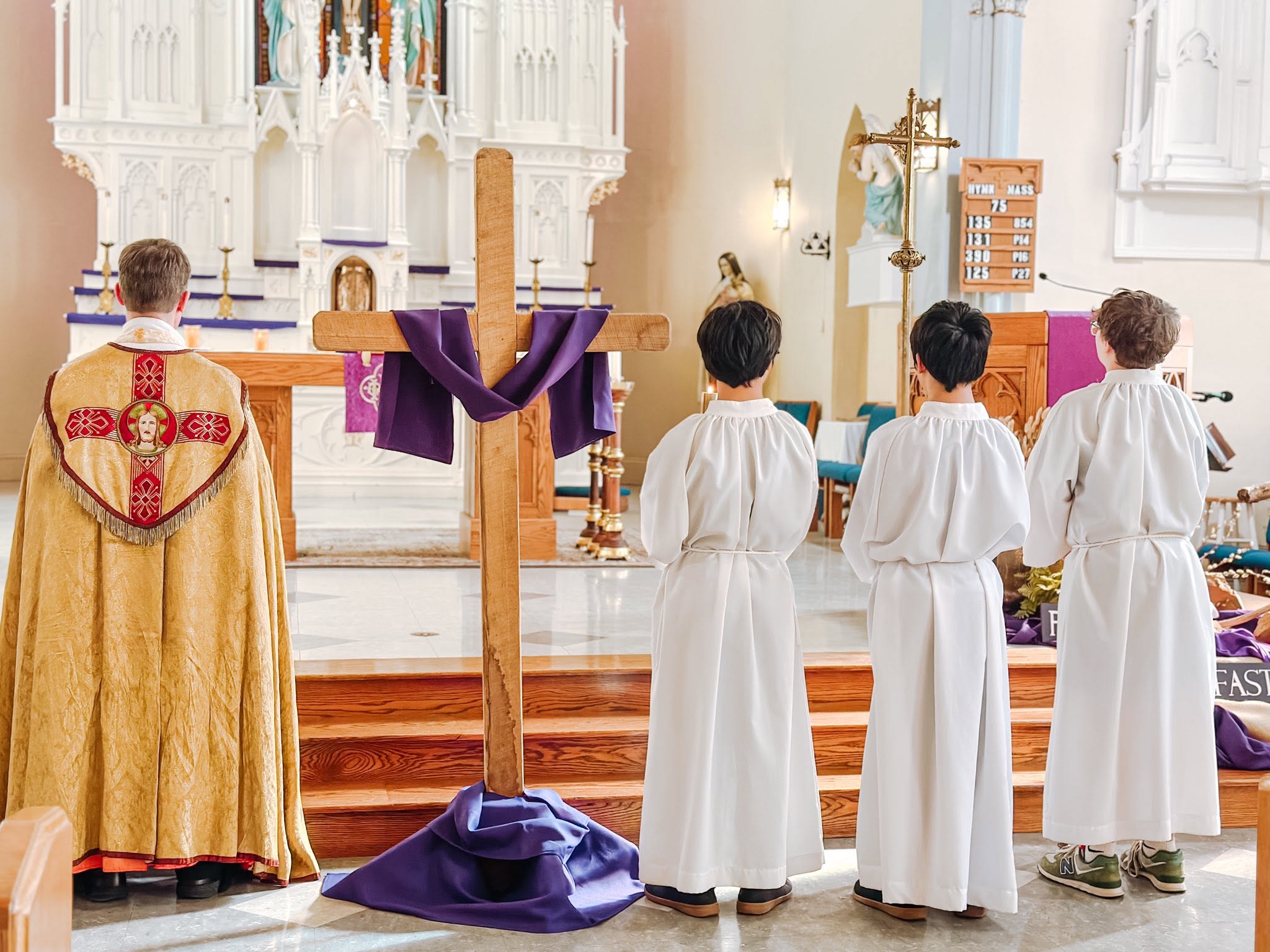
SPIRITUAL GROWTH & VALUES
SMS instills faith formation and values and provides many community activities and field trips outside of school.
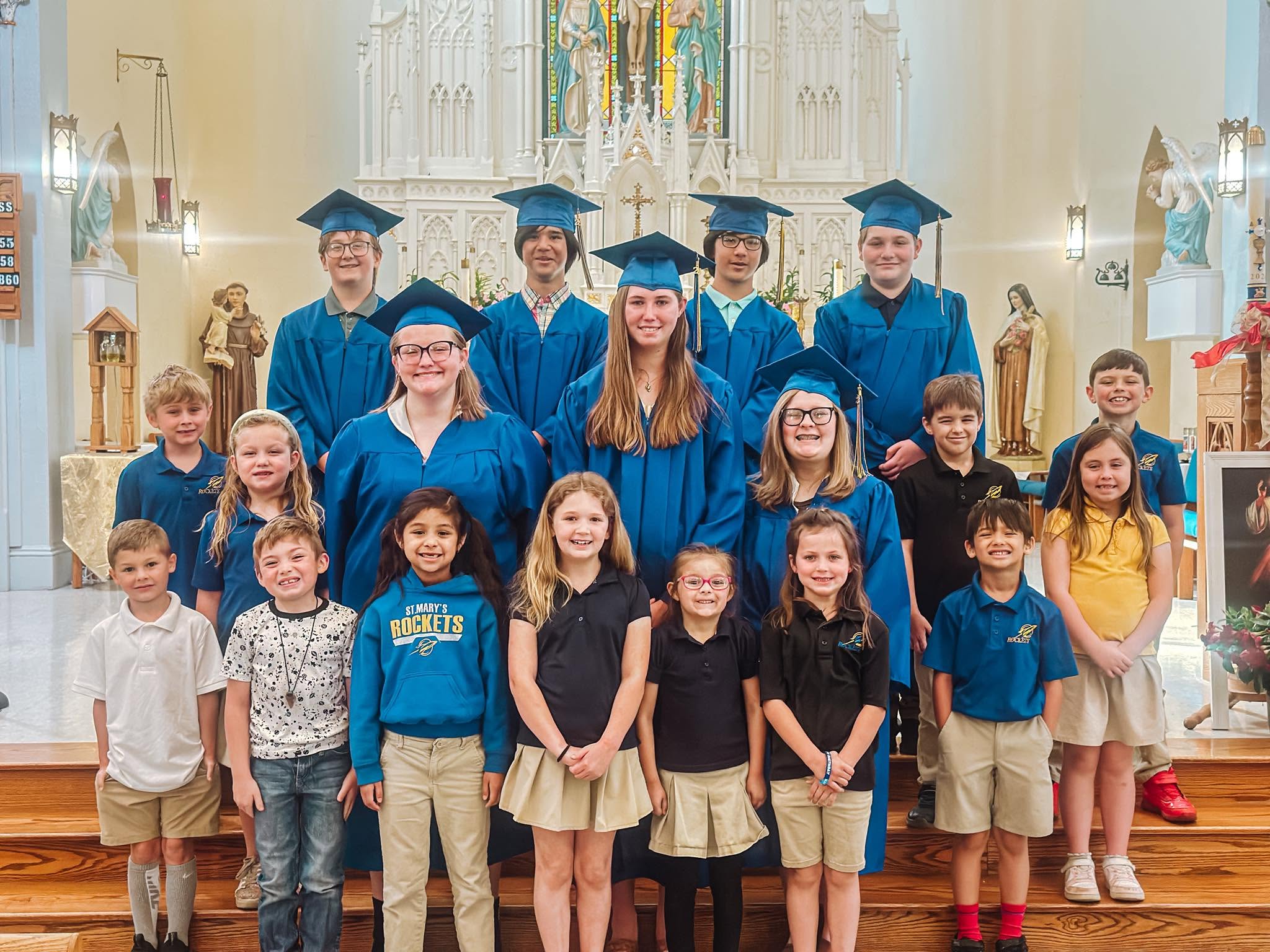
Academic EXCELLENCE
Passionate teachers use creative lessons to inspire students to achieve beyond their expectations

CONNECT
ST. MARY’S ON FACEBOOK
Page likes: 1,471
Saint Mary's Catholic School
(opens in a new tab)Saint Mary's School Official Facebook Page! Like and Follow to keep updated with all the latest school news and happenings!
+JMJ+SUNDAY BIBLICAL MASS READINGS AND QUESTIONSfor Self-Reflection, Couples or Family Discussion24th Sunday of Ordinary Time – Sunday, September 13th, 2026The First Reading - Sirach 27:30-28:7Wrath and anger are hateful things, yet the sinner hugs them tight. The vengeful will suffer the LORD’s vengeance, for he remembers their sins in detail. Forgive your neighbor’s injustice; then when you pray, your own sins will be forgiven. Could anyone nourish anger against another and expect healing from the LORD? Could anyone refuse mercy to another like himself, can he seek pardon for his own sins? If one who is but flesh cherishes wrath, who will forgive his sins? Remember your last days, set enmity aside; remember death and decay, and cease from sin! Think of the commandments, hate not your neighbor; remember the Most High’s covenant, and overlook faults. Reflection Today’s First Reading is itself a meditation on earlier Scriptures like Lev 19:17-18: “You shall not hate your brother in your heart, but you shall reason with your neighbor, lest you bear sin because of him. You shall not take vengeance or bear any grudge against the sons of your own people, but you shall love your neighbor as yourself: I am the LORD.” Oftentimes we contrast the teaching of Jesus Christ with the instruction of Old Testament, especially on certain issues like marriage and divorce (cf. Deut 24:1-4; Matt 19:3-9). Today’s Readings, however, stress the continuity of Jesus’ teaching with the early Scriptures. “Do not think that I have come to abolish the law and the prophets; I have not come to abolish them but to fulfill them” (Matt 5:17). The “covenant” that Jesus ben Sira refers to here seems to be the Mosaic or Sinai covenant, which in its law included such commands as Lev 19:17-18 above. Forgiveness and love toward the neighbor are not simply ethical counsels or a part of the natural law: they are a covenant obligation, part of one’s duty toward the God who has entered into a faithful, familial relationship with you. Adults - Is forgiveness easy for you? How can prayer help you?Teens - Do you pray for those who persecute you? Why is this something we are instructed to do?Kids - Pray and ask Jesus to help you share His mercy with others. Responsorial- Psalm 103:1-2, 3-4, 9-10, 11-12 R.The Lord is kind and merciful, slow to anger, and rich in compassion.Bless the LORD, O my soul;and all my being, bless his holy name.Bless the LORD, O my soul,and forget not all his benefits.R. The Lord is kind and merciful, slow to anger, and rich in compassion.He pardons all your iniquities,heals all your ills.He redeems your life from destruction,crowns you with kindness and compassion.R. The Lord is kind and merciful, slow to anger, and rich in compassion.He will not always chide, nor does he keep his wrath forever.Not according to our sins does he deal with us,nor does he requite us according to our crimes.R. The Lord is kind and merciful, slow to anger, and rich in compassion.For as the heavens are high above the earth,so surpassing is his kindness toward those who fear him.As far as the east is from the west,so far has he put our transgressions from us.R. The Lord is kind and merciful, slow to anger, and rich in compassion. Reflection The Psalm calls to our mind the memory of God’s greatest revelation of himself in the Old Testament, his self-revelation to Moses, where God proclaimed his “Name” (Exod 33:19), that is, his true nature. To our surprise, God chooses not to reveal his nature as power and majesty, but as “mercy and faithfulness.” The common statement, “God’s greatest attribute is his mercy,” is a truth deeply rooted already in the Old Testament. What do you think of when you think of God’s mercy?The Second Reading- Romans 14:7-9Brothers and sisters: None of us lives for oneself, and no one dies for oneself. For if we live, we live for the Lord, and if we die, we die for the Lord; so then, whether we live or die, we are the Lord’s. For this is why Christ died and came to life, that he might be Lord of both the dead and the living.Reflection - In the Second Reading St. Paul reminds us that we are completely given over to the Lord. In light of the surrounding readings, we realize: if we have been totally assimilated to Jesus, such that our life is his life and our death is his death, what sense does it make to continue to hold onto unnecessary grudges about what others have done to us? Aren’t we living on a whole new plane, where the cycle of offense and revenge of our old life don’t make sense any more? -Is there something in your life you are struggling to give to the Lord?The Holy Gospel according to Matthew 18:21-35Peter approached Jesus and asked him, “Lord, if my brother sins against me, how often must I forgive? As many as seven times?” Jesus answered, “I say to you, not seven times but seventy-seven times. That is why the kingdom of heaven may be likened to a king who decided to settle accounts with his servants. When he began the accounting, a debtor was brought before him who owed him a huge amount. Since he had no way of paying it back, his master ordered him to be sold, along with his wife, his children, and all his property, in payment of the debt. At that, the servant fell down, did him homage, and said, ‘Be patient with me, and I will pay you back in full.’ Moved with compassion the master of that servant let him go and forgave him the loan. When that servant had left, he found one of his fellow servants who owed him a much smaller amount. He seized him and started to choke him, demanding, ‘Pay back what you owe.’ Falling to his knees, his fellow servant begged him, ‘Be patient with me, and I will pay you back.’ But he refused. Instead, he had the fellow servant put in prison until he paid back the debt. Now when his fellow servants saw what had happened, they were deeply disturbed, and went to their master and reported the whole affair. His master summoned him and said to him, ‘You wicked servant! I forgave you your entire debt because you begged me to. Should you not have had pity on your fellow servant, as I had pity on you?’ Then in anger his master handed him over to the torturers until he should pay back the whole debt. So will my heavenly Father do to you, unless each of you forgives your brother from your heart.” Reflection Looking at the context of Matthew 18, we see that a few verses earlier, Jesus had conferred on his disciples a certain religious authority, the authority to “bind and loose,” to make solemn judgments on the application of divine law (halakhah). The authority of the disciples to “bind and loose” also reminds us of the authority conferred after the resurrection, when Jesus breathes on his disciples and says, “Whose sins you forgive are forgiven them, whose sins you retain are retained” (Jn 20:22-23). The two passages seem to have an analogy to one another and may be mutually illuminating. Now Peter, the head of the apostles who will have the authority to forgive sin, approaches Jesus to question him about the freedom with which he should dispense forgiveness. He thinks he is being generous: “Shall I forgive up to seven times?” Jesus responds, “Not seven times, but seventy times seven.” “Seventy times seven” is ten jubilees. It is a Great Jubilee. It is a number which symbolizes an abundance of all that the Jubilee stands for: release, forgiveness, restoration of relationships. For many Jews, the Messiah was expected at the end of “seventy times seven” years, and then he would announce the Great Jubilee. Jesus is this Messiah.Adults - How has God’s forgiveness changed your life? Teens - How can you show God’s mercy that has been given to you, to others?Kids - What helps you forgive someone?LIVING THE WORD OF GOD THIS WEEK! - We had better stop and think for a moment today and reflect that we ourselves may be that merciless servant described in the parable. Every time we have sinned mortally we have incurred an unpayable debt to God. Each time we have received absolution we have come out of God's courtroom as free men. A weight greater than a million dollar debt has been lifted from our shoulders. A fate worse than generations of earthly imprisonment — that is, eternal slavery — has been spared us because of God's loving, infinite mercy. How then can it happen that we could be so heartless, mean, and foolish as to refuse to forgive a neighbor for some offense he has committed against us? We still have time to put our affairs in order. We still can forgive all our enemies from our heart. Let us not miss the gift of this opportunity!
- Comment below and give this post a share if you’re excited for 8th grades first service project! Monday from 7:15-8:00 am you can snag an iced or black coffee in the back parking lot of SMS. This weeks coffee bar sponsored by: Van Matre Plumbing and served by 8th graders. They will be serving up some tasty coffees for FREE WILL DONATION! 💜Parents - please drop students off BEFORE heading to grab your coffee! Safety is our top priority! 🙂
Just a reminder: We have Art Club September 15th 3:00 to 4:30. Art Club members can wear their old club t-shirts and blue jeans. New shirts have been ordered
